
Inquiry By Design offers seamless, easy-to-use, digital amplifications for all secondary units. Our digital toolkits help teachers create rich communities of learners through collaborative discussion and brainstorming. Embedded within each toolkit are opportunities to scaffold learning through daily touchpoints, support peer-to-peer and teacher feedback, provide differentiated, genre-based writing instruction, and much more!
See the below resources as samples of what each unit brings to the table.
Introduction to Interpretive Work - Grade 6
Introduction to Interpretive Work is designed to provide students with an opportunity to deepen their understanding of the kinds of work people do with texts in English. Specifically, the work in this unit provides students with an opportunity to experience the practices of close reading as well as interpretive work distinguished by clear interpretive statements that are supported by compelling explanations and anchored in specific moments in the text. This type of interpretive work falls under the category of argument, as students learn to stake out a clear position and build a careful case for it.

Writing Tasks
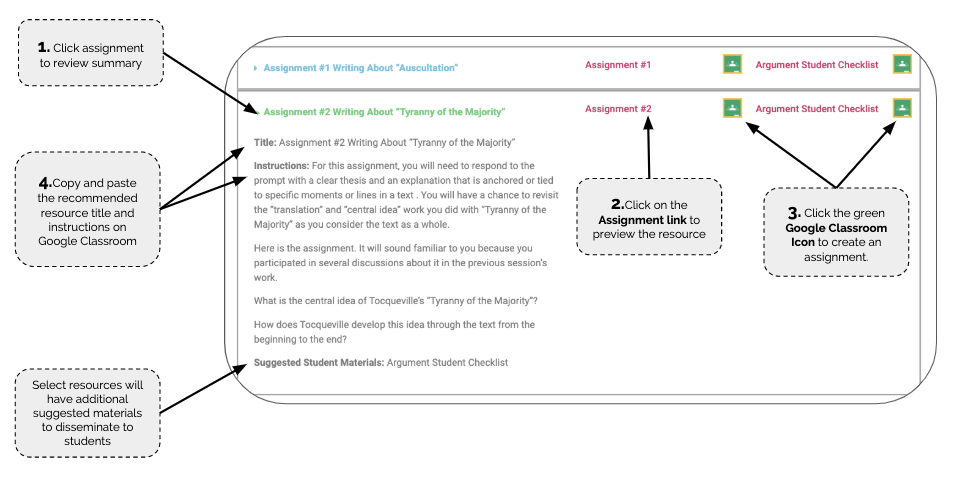
Title: Argument Interpretive Assignment #1 Writing About “Raymond’s Run”
Instructions: For this assignment you will write an argument about “Raymond’s Run” that answers the question in the box below. lt will sound familiar to you because you participated in a discussion about it in the previous session’s work.
Squeaky, the narrator in the story “Raymond’s Run,” has a lot of strong opinions. One of these comes at the end of the story, when she uses the phrase “like being people.
What do you think this phrase means to Squeaky?
Suggested Student Materials: Argument Student Checklist
Charts for Discussion
Title: “Raymond’s Run” – Comprehension Questions
Teacher Manual Instructions:
Session 2
Take 5-7 minutes to facilitate a whole-class discussion about the three comprehension questions. Use this time to help students articulate their understanding of the characters and the events in “Raymond’s Run.” To verify understanding and to provide an artifact that students can consult in the sessions ahead, consider capturing the class’ answers to the compre- hension questions on a chart.
Title: How is forming an interpretation different from responding to a comprehension question?
Teacher Manual Instructions:
Session 5 and 9
Reconvene the whole class to discuss the question. Capture the class’ thinking about this on a chart. You might organize the responses by creating a simple T-chart, dedicating one column to features of comprehension work and the other to interpretive work. Afterwards, be sure to post this list in the room so that students can consult it as needed. (This is a “working chart,” which means the class will have opportunities to revise and add to it in the sessions ahead. You will use this chart in Session 5 and 9.)
Dealing With Difficulty - Grade 9
Dealing With Difficulty is a two part unit that was designed as part of Inquiry By Design’s efforts to ensure that secondary students have regular and supported opportunities to work with difficult texts. Each study at each grade level is an excursion into difficulty that is important in and of itself, but that is also valuable because it supplies a basis for reflection and comparison in subsequent experiences with difficult texts.
Writing Tasks
Title: Small-Groups: Difficulty in “Auscultation” What and Why?
Teacher Manual Instructions:
Session 1
- Ask students to work independently for a moment to review their difficulty markings in “Auscultation” and to identify three moments or lines they marked. Give students 4-5 minutes to make an entry for each line or moment on the chart they created in their notebook. Remind students to be sure to copy down the line number and an excerpt of the moment as it is written in the essay in the “What is difficult?” column. If the selection is especially long, students can copy the line numbers and a small portion of the quote for reference. If students have marked numerous moments, challenge them to choose the ones they think are most important or most confusing.
Next, place students in pairs or trios and ask them to share their chart entries with their partner(s). Give each group a piece of chart paper and a marker and ask students to work together to create a master “What’s difficult?/ Why is it difficult?” chart for their group. Explain that at the end of the small-group work, each group will post its chart on the wall so the rest of the class can review it and all of the other charts prior to the upcoming whole-group discussion. Give groups 7-10 minutes to build their charts.
Title: Small-Groups: ““Auscultation” Sections and Chunks
Teacher Manual Instructions:
Session 2
- Place students in pairs or trios and then disseminate the assignment.
Lead the whole group through this task for the first section or chunk.
Afterwards, answer any questions students have about that work and then give the small groups the remainder of the work period to complete both lists for each of the remaining chunks or sections.
Title: Small-Groups: Retelling “Auscultation” Search and Study
Teacher Manual Instructions:
Session 3
Place students in pairs or trios.
Negotiate expectations and rules regarding issues such as accessing dictionaries, using the Internet (on either computers or phones), or consulting other resources that students might require during their search and study work.
Give students time to meet in their small groups to complete the search and study work for the remaining sections of the essay. Groups may need time beyond this class meeting to complete this task.
Title: Assignment #1 Writing About “Halloween Party”
Instructions: For this assignment you will write an argument about “Auscultation” that answers the question in the box below. It will sound familiar to you because you participated in a discussion about it in the previous session’s work:
What is Church’s primary message in “Auscultation”?
Suggested Student Materials: Argument Checklist
Charts for Discussion
Title: Difficulty in “Auscultation” What and Why?
Teacher Manual Instructions:
Session 1
Next, sketch out a two-column chart like the one below and ask students to create one like it in their notebooks.
Model making an entry in the “Difficulty” chart. Point out that there may be many kinds of difficulties that showed up for students: difficult words, difficult or confusing sentences, difficult ideas, unusual links made by the author, etc. Focus your modeling on showing how a “difficult moment” is one where you may have felt confused or may have stopped understanding the ideas. Point out that answering the question “Why is this difficult?” is actually something you need to stop and think about—be as specific as possible as you explain why it’s difficult. This will later help us think through the difficulty.
CLOSING MEETING
- Distribute masking tape and have the groups post their charts on
the classroom walls so that the class can conduct a “gallery walk” where students take a few minutes to walk around the room and read the work on each chart. - Give students 3-5 minutes to walk around and read the other charts in the room.
- Convene a whole-class discussion about the work. You are not trying to resolve these questions right now because there is time set aside for that work in the next sessions. You might initiate the conversation by saying something like this:
- “Let’s take a look at what you guys think is difficult in the essay and what it is about those moments or lines that you think make it difficult.”
- During this conversation, be sure to capture the class’s thinking on a new chart titled “Difficulty in ‘Auscultation’: What and Why?” that can be displayed for the whole class to see. (You will need to display this chart in the next session.) This conversation is a chance for the class to notice overlaps across groups and to benefit from the thinking each group did.
Title: Making Sense of “Auscultation”
Teacher Manual Instructions:
Session 4
Reread the difficult moment and invite one or two volunteers to offer ideas about this. Encourage other students to extend, push back, or otherwise respond to these ideas. After discussing this with the class for 4-5 minutes, work with the group to craft entries for the second and third columns. (Students should add these model entries to their notebook charts as well.)
©2020 Inquiry by Design, Inc.