What Are Targeted Writing Lessons?

Targeted Writing Lessons (TWLs) are exactly that—a collection of instructional resources targeted to specific student needs in writing. Each of these lessons is intended to respond to a demonstrated need by providing a small bit of direct instructional information, followed by a clear task requiring students to use or practice that instruction in the context of a writing response they are already developing. The lessons close with recommendations to students about how to integrate this writing into the draft they are writing or revising

How Should They Be Used?

The idea behind TWLs is that students should have an opportunity to learn and practice writing skills in the context of writing tasks they are already working on. Rather than piling on new and inauthentic writing tasks, the TWLs seek to amplify the writing and revision process of existing work.

Teachers can determine which TWLs best fit their students’ needs by reviewing student work with the Inquiry By Design integrated ELA rubric: each score on the rubric corresponds to skills and lessons in the TWL list. The list of TWLs under each rubric score reflects the skills a student needs to develop in order to reach the next highest score on the rubric.
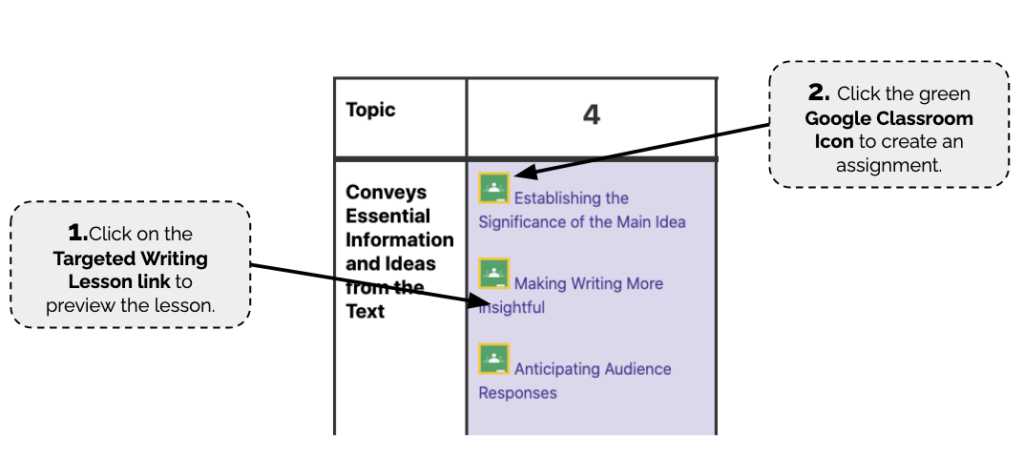
Email info@inquirybydesign.com for purchasing details. Full purchase includes all Targeted Writing Lessons listed below ready to share through Google Classroom. Other genres include informational/explanatory and narrative.
Topic

4

3

2

1

Comprehensive Understanding
Clear Claims: Making a Claim More Insightful

Anticipating Audience Responses

Establishing the Significance of the Claim

How Do I Know My Evidence Is Relevant?

Clear Claims: Choosing and Writing Supportable Claims

Clear Claims: Choosing and Writing Arguable Claims

Clear Claims: Refining Your Claim for Specificity

Displaying Your Understanding of the Whole Issue

Clear Claims: Making a Claim More Insightful

Providing Context

Constructing Compelling Explanations

Anticipating Audience Responses

Establishing the Significance of the Claim (11-12)

How Do I Know My Evidence Is Relevant?

Clear Claims: Choosing and Writing Supportable Claims

Clear Claims: Choosing and Writing Arguable Claims

Clear Claims: Refining Your Claim for Specificity

Displaying Your Understanding of the Whole Issue

Providing Context

Providing Evidence: Moving From Weak to Strong

Anticipating Audience Responses

Establishing Evidence in Literary Arguments
Attacking the Prompt

Components of an Argument

A Claim From Scratch

Chunking and Retelling for Comprehension

Establishing Evidence in Literary Arguments
Organization

Varying Your Claim/Evidence/Warrant Structure

Beyond Basic Transitions

Connecting Claims and Evidence With Warrants

Varying Your Claim/Evidence/Warrant Structure

Using Transitions

Beyond Basic Transitions

Incorporating Counterclaims into Organization (7-12)

Compelling Conclusions Agree AND Disagree: Introducing Counterclaims and Alternate Positions (7-12)

Connecting Claims and Evidence With Warrants

Organizing Your Argument: Sorting Evidence

Organizing Your Argument: Ordering Subclaims

Using Transitions

Incorporating Counterclaims into Organization (7-12)

Compelling Conclusions

Agree AND Disagree: Introducing Counterclaims and Alternate Positions (7-12)

Organizing Your Argument: Sorting Evidence

Organizing Your Argument: Ordering Subclaims

Attacking the Prompt

Components of an Argument

A Claim From Scratch

Generating a Counterclaim (7-12)

Using Transitions

Agree AND Disagree: Introducing Counterclaims and Alternate Positions (7-12)

Development

Varying Your Claim/Evidence/Warrant Structure

Being Concise

How Do I Know My Evidence is Relevant? (6-12)

Clear Claims: Choosing and Writing Supportable Claims

Providing Context

Connecting Claims and Evidence with Warrants

Varying Your Claim/Evidence/Warrant Structure

Incorporating Evidence Smoothly

Constructing Compelling Explanations

Anticipating Audience Responses (9-12)

Incorporating Counterclaims into Organization (7-12)

Developing Counterclaims Fairly and with Evidence (9-12)

Agree AND Disagree: Introducing Counterclaims and Alternate Positions

How Do I Know My Evidence is Relevant? (9-12)

Clear Claims: Choosing and Writing Supportable Claims

Providing Context

Connecting Claims and Evidence With Warrants

Generating a Counterclaim (7-12)

Incorporating Evidence Smoothly

Constructing Compelling Explanations

Anticipating Audience Responses (9-12)

Incorporating Counterclaims into Organization (7-12)

Developing Counterclaims Fairly and with Evidence (9-12)

Establishing Evidence in Literary Arguments

Agree AND Disagree: Introducing Counterclaims and Alternate Positions (7-12)

Providing Evidence: Moving From weak to strong

Attacking the Prompt

Components of an Argument

A Claim From Scratch

Chunking and Retelling for Comprehension

Establishing Evidence in Literary Arguments
Lanugage and Syntax

Advanced Syntax: Using Rhetorical Devices

Being Concise

Maintaining Objective Tone

Avoiding Overwriting

How to Sound Authoritative

Incorporating Evidence Smoothly

Creating Basic Sentence Variety

Advanced Syntax: Using Rhetorical Devices

Being Concise

Maintaining Objective Tone (9-12)

Avoiding Overwriting

How to Sound Authoritative

Incorporating Evidence Smoothly

Creating Basic Sentence Variety

Being Concise

Maintaining Objective Tone (9-12)